
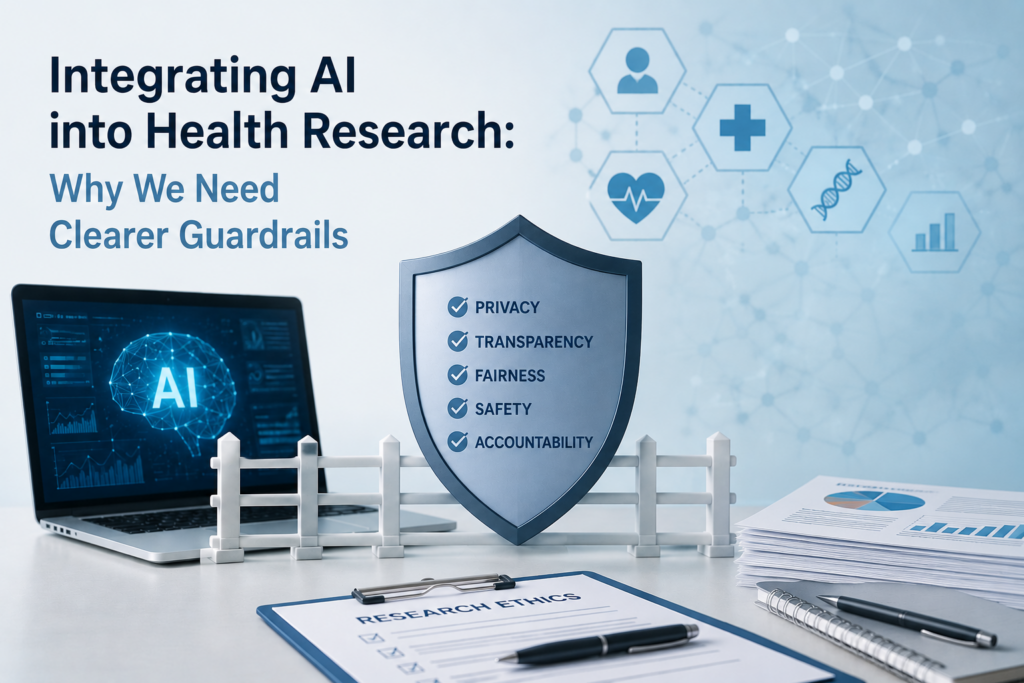
Artificial intelligence is rapidly becoming part of everyday health research. Researchers now have access to tools that can generate code, summarize literature, conduct statistical analyses, and even propose research questions in a matter of seconds. These technologies offer tremendous opportunities to improve efficiency and expand scientific capacity.
Yet, as AI capabilities advance, an important question emerges: How do we integrate these tools without compromising the methodological rigor that underpins trustworthy health research?
Our new perspective in npj Digital Medicine, Integrating Artificial Intelligence Tools in Health Research, explores this challenge and proposes practical approaches for ensuring that AI strengthens, rather than weakens, scientific integrity. This work is a product of our SOLIDERA initiative in collaboration with our partners in Switzerland.
The Challenge: Two Different Research Traditions
Many contemporary AI tools originate from data science environments. These workflows often prioritize prediction, pattern recognition, and iterative experimentation using existing datasets.
Health research, however, is grounded in a different tradition. Fields such as epidemiology emphasize prespecified study designs, causal reasoning, transparency, reproducibility, and rigorous approaches to minimizing bias.
While data science and health research approaches can be complementary, they are not interchangeable.
An AI tool that generates an impressive statistical model may still overlook fundamental epidemiological principles, such as identifying appropriate confounders, constructing causal frameworks, or distinguishing association from causation. As a result, researchers may receive outputs that appear credible but fail to meet established scientific standards.
What We Learned from Testing AI Tools
To illustrate these challenges, we examined how a multimodal AI system handled a relatively straightforward epidemiological question: What is the causal effect of smoking on heart attack risk?
The results were instructive.
In one example, the system produced functional code and statistical outputs but completely omitted causal modeling approaches that epidemiologists routinely use. In another, it generated a directed acyclic graph (DAG) that lacked meaningful connections to existing medical knowledge and then failed to incorporate that framework into the subsequent analysis.
The outputs looked sophisticated, yet important methodological errors remained hidden beneath the surface. These findings reinforce an important lesson: plausible does not necessarily mean correct.
Moving Toward Human-AI Collaboration
Rather than viewing AI as an autonomous replacement for researchers, we argue that health research should embrace a human-in-the-loop approach. Researchers must continue to perform the scientific equivalent of peer review on AI-generated outputs: questioning assumptions, validating code, checking causal logic, and ensuring that analyses align with disciplinary standards.
To support this process, we propose a five-level automation framework that helps researchers determine where and how AI tools can appropriately contribute to different stages of the research lifecycle. Lower levels of automation involve tightly supervised tasks, while higher levels grant increasing autonomy. In high-stakes clinical and population health settings, maintaining meaningful human oversight remains essential.
Six Recommendations for Responsible AI Integration
Our perspective also outlines six practical recommendations for integrating AI into health research workflows. These recommendations emphasize:
- Preserving established scientific methodologies and disciplinary standards
- Explicitly incorporating causal reasoning into AI-assisted analyses
- Maintaining transparency and reproducibility in both code and decision-making
- Defining clear boundaries for AI autonomy
- Encouraging critical review of all AI-generated outputs
- Keeping human accountability at the center of the research process
These principles are not intended to slow innovation. Instead, they provide the guardrails needed to ensure that technological advances translate into trustworthy and impactful science.
Looking Forward
AI will undoubtedly become an increasingly important part of health research. The question is no longer whether researchers should use these tools, but rather how they can be integrated responsibly. The future of health research will likely involve close collaboration between human expertise and AI-based research tools, combining computational efficiency with domain knowledge, causal reasoning, and ethical judgment. By developing clear guardrails today, we can help ensure that AI augments scientific discovery while preserving the rigor and accountability that patients, clinicians, and society depend upon.
Read the full artilce in npj Digital Medicine here.